"Crafting Timeless Designs, One Stitch at a Time."

Showing posts with label Beginner Sewing Tips. Show all posts

Friday, April 24, 2026

Small Space Sewing Tips

Small space sewing room with pegboard storage, sewing machine, and organized fabric, showing how to utilize space efficiently.

A beautifully organized small sewing space using vertical storage, smart tools, and minimal clutter to maximize creativity and efficiency.


Utilize What You Have In Your Small Sewing Space


Dear Readers and Subscribers,

It takes ingenuity to sew and craft in a small space. Some of you have small spaces to sew in, either by choice or not. It can be challenging to have any hobby or craft in a small space because we need supplies, tools, and patterns. Most hobbies are about acquiring as much stuff as quickly as possible. But when you think about what you actually need for your projects, you start to consider the storage capacity you actually have. What stays? What goes? This article gives you tips on how to save space in your sewing room so you find solutions rather than more challenges.


Buy Virtual Or Digital Products To Store On Your Device

Buy digital versions of patterns, books, and magazines. This way, you print what you need when you need it, and store it on your device—not on a shelf or desk taking up space. When you're finished, your pattern can go into a recycling bin. If you need it again, you can print it again from your device. Make a list in a journal of all the digital patterns you have, without storing them in your sewing space. This alone saves a lot of space in your sewing room. This is one of the reasons I offer digital sewing resources in my sewing shop.


Don't Overbuy Fabric, Tools, and Supplies

It is important to understand the capacity of your sewing room—not just visually, but also quantitatively. Some containers can store up to 60 fat quarters, totaling 15 yards of fabric, enough to sew many projects. A 500-meter spool of thread can sew one project. By doing this, you can easily relate to what you actually consume in a given time. Small spaces don't have the luxury of a 3-year supply. Keep a record of what you've used so you don't bring in new items until you have created new space with outgoing projects.


Don't Spread Out

Use your walls to expand your storage space. Think vertically. Don't spread out—spread up. Use pegboards to expand your zones. You can purchase pegboards with hooks, shelves, and containers at hardware stores, Walmart, craft stores, or online retailers such as Amazon.


Share Sewing Tools 

This can be a bit tricky if it bothers you to loan your tools. But there are some items you need only once or twice a year for a particular project. Instead of purchasing them and having to store them in space you don't have, call one of your sewing friends to see if they may have what you are looking for. There are also sewing guilds where you can check out tools and return them like a library book.


Trade Your Fabric 

We always love other people's stash, don't we? Where do they find all of their beautiful fabric in their stash? That's always my question. Instead of buying new fabric, trade fabric. Fabric looks so much better in a finished sewing project than in the back of a drawer. Plus, fabric can be forgotten when it sits in the back of a drawer, too. If you cannot trade fabric, sell it online. It has been tried and proven that someone is looking for what you have.


Make The Hard and Painful Choices

Your small space has room only for the essentials. It's not about how you're going to fit it all into your space—it's about whether you're keeping this item or that item. These are hard choices that aren't easy to make. It takes all of us a long time to build and acquire our sewing tools, and some of these choices are downright painful. But you will be more successful and creative in a free, uncluttered sewing room that isn't crowded or hard to move around in. Free space allows more creative projects to enter your mind.


Make Every Tool Count

Can you condense your tools? For instance, instead of a regular iron and a travel iron, combine them with a portable iron. Can you make do with 2 rotary cutters instead of 4? Can you work with a limited range of neutral-colored thread? What else can you eliminate to open more space in your sewing area? More likely, as your skills improve, the tools you use will change or be upgraded, and you will remove those you no longer use.


Limit Your Sewing Projects

Keeping one active and one slow project keeps projects under control. You will discover you can still have quick fun with easy or small projects.


Consume Your Scraps Immediately

Small spaces don't have room to collect scraps. Use them immediately by incorporating them into small sewing projects or scrap projects. Some of the best gifts made throughout the year are nothing more than scraps sewn into beautiful, useful projects.


Get Those Unfinished Sewing Projects Done

Don't let your attention become distracted or divided. So many projects to choose from—oh my! Finish each sewing project first before you start another one. I know how it is: you see something online and want to sew it immediately. Make a running list of those whimsical or spur-of-the-moment sewing projects you want to do, and sew them one at a time.


As much as we wish it were true, there are no magical solutions in small sewing spaces. Sewing with less can be more, with its own kind of fun. The challenge to use what you have can push your creativity toward innovative, clever designs. For that, you can be grateful—because one-of-a-kind designs are what everyone is looking for!

Is this article informative and helpful to you? If so, subscribe to The Designer's Needle in the sidebar for more articles like this delivered to your inbox!


Sunday, April 6, 2025

🧵 How to Choose the Right Sewing Pattern: A Smart Sewist's Guide

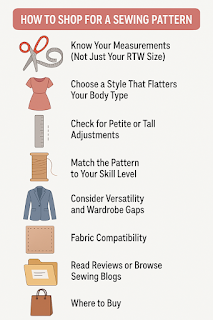
"Checklist graphic titled 'How to Shop for a Sewing Pattern' with icons and tips for choosing sewing patterns based on measurements, body type, and skill level."
Use this quick-reference checklist to shop smarter for sewing patterns that fit your body, flatter your shape, and match your sewing skill level.


Choosing the correct sewing pattern is a blend of inspiration, knowledge, and strategy. Whether you're a beginner or a seasoned maker, your success in sewing starts with selecting a pattern that matches your body, skill level, and wardrobe goals.


In this post, I’ll walk you through everything you need to know before clicking “Add to Cart” so you can choose your next sewing project with total confidence.


✅ 1. Know Your Measurements (Not Your Store Size!)

Sewing pattern sizes differ from those found in stores. You might wear a size 10 off the rack but need a size 14 in patterns. That’s why it’s essential to understand sewing pattern sizes before making a purchase.


Take accurate body measurements:

Bust

Waist

Hips

Back waist length

Then, compare those to the size chart on the sewing pattern envelope. If you’re between sizes, many patterns show how to blend them for a better fit.


A sewing pattern measurement chart with garment sizes and corresponding bust, waist, hip, and back waist length in inches.
Use this measurement chart to find your sewing pattern size based on bust, waist, hip, and back waist length—essential for a proper fit.


👗 2. Choose a Style That Flatters Your Body Type


Part of choosing the best sewing pattern is finding styles that highlight your natural shape. Here’s an essential guide:

Pear-shaped: A-line skirts or detail on top to balance your silhouette

Apple-shaped: Empire waists and wrap dresses are flattering choices

Hourglass: Look for patterns that accentuate the waist with darts or belts

Rectangle: Try adding shape with gathers, flares, or ruffles

Want to learn how to read a sewing pattern to find the right fit? Check the line drawings on the back—they reveal how the garment is constructed and where it adds volume or shaping.


📏 3. Adjust Patterns for Petite or Tall Frames


Fit isn’t just about width—it’s also about length. Some patterns are labeled “Miss Petite” or “Tall”, but even if they’re not, you can often adjust the pattern using built-in lengthen/shorten lines.

This is crucial when you're learning how to fit sewing patterns to your body.


🧵 4. Choose Patterns That Match Your Skill Level


All sewing patterns come with a skill rating:

Beginner: Simple shapes, easy fabrics, few pieces

Intermediate: Darts, zippers, sleeves, and linings

Advanced: Tailoring techniques, delicate fabrics, and more shaping

If you’re just starting out, look for the best sewing patterns for beginners—these help you build confidence without frustration.


🧥 5. Match the Pattern to Your Wardrobe & Lifestyle


Choose sewing patterns that work with your daily life. Ask yourself:

Will I wear this often?

Can I mix and match it?

Is it seasonally appropriate?

Look for wardrobe patterns or capsule wardrobe sewing patterns with multiple versions in one envelope—ideal for stretching your creativity and wardrobe.


🎨 6. Check the Recommended Fabrics


Always look at the recommended fabric list on the back of the pattern. It ensures the garment will drape and behave the way it’s designed to.

Lightweight woven fabrics for breezy garments

Knits for body-hugging styles

Structured fabrics like denim or linen for tailored pieces

Also, double-check yardage, notions, and pattern layout before shopping.


📝 7. Read Reviews and Research Before You Buy


Learning how to choose a sewing pattern becomes easier when you see what others have done with it. Use:


YouTube sew-alongs and tutorials

Instagram hashtags like #McCalls7845 or #ButterickPatterns

This helps you discover tips, fabric choices, and even common issues before you start cutting.


🛍️ 8. Where to Buy Sewing Patterns


Great sewing patterns are available from:

Craft stores like Michaels or Hobby Lobby

Indie pattern companies (Closet Core, Cashmerette, Tilly and the Buttons)

Etsy for downloadable PDFs

Bonanza, eBay, or Etsy for vintage & out-of-print patterns

🧡 Looking for doll clothes or vintage-style wardrobe patterns? Visit my The Needle Market shop


🙋‍♀️ FAQ: Choosing a Sewing Pattern


Q: How do I determine the correct sewing pattern size to purchase?

A: Use a measurement chart and compare your bust, waist, and hips to the size guide on the envelope. Don’t rely on your store size!

Q: What are the best sewing patterns for beginners?

A: Look for patterns labeled “Beginner.” These usually have fewer pieces, stable fabrics, and simple shapes—perfect for learning.

Q: How do I fit sewing patterns to my body?

A: Use size blending for adjustments to the bust, waist, and hips. Petite or tall? Look for patterns with lengthened or shortened lines to tweak bodice or skirt lengths.

Q: How do I read a sewing pattern?

A: The back of the envelope tells you the size chart, fabric suggestions, yardage, and required notions. Inside, you’ll find layout guides, construction steps, and tips.


Learning how to shop for a sewing pattern is part of the creative process. Once you master it, you'll avoid common mistakes and sew garments that actually fit your lifestyle and body.


Do you have a favorite go-to pattern or shopping tip? Share it in the comments—I’d love to hear what works for you!


How to Decide Where a Garment Should End on Your Body

Where a garment ends can change its balance, proportion, comfort, and overall style. Try different hem and sleeve lengths before finishing y...